A Sovereign Mercy reader extra
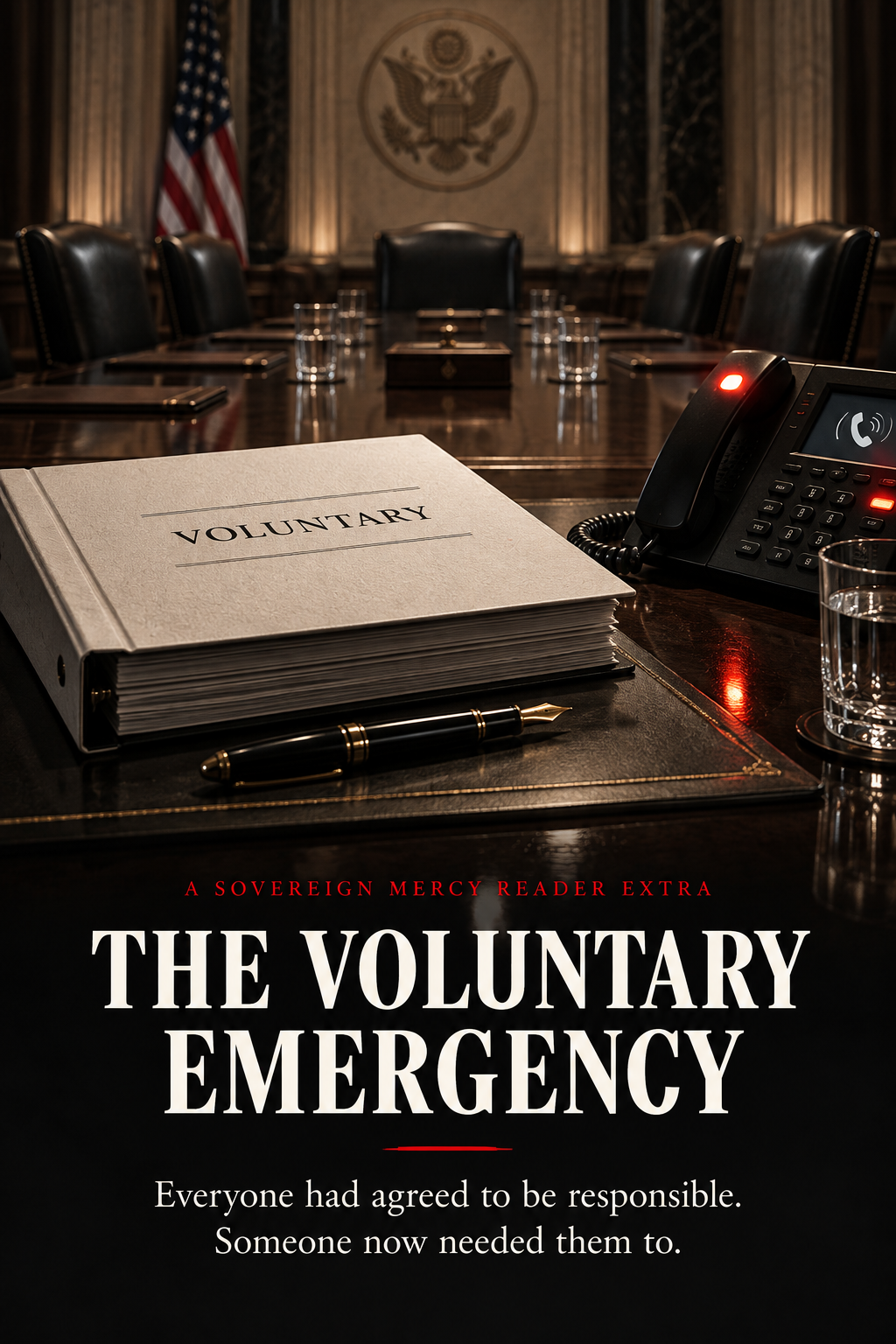
The Voluntary Emergency
Everyone had agreed to be responsible. Someone now needed them to.
This is a fictional follow-up briefing inspired by the September 29, 2026 White House meeting on AI safety. The accord, executive order and attributed quotations are real. The briefing, its characters and the emergency are invented. This story sits outside the novel’s canon.
The first emergency concerned the font.
The presentation said ARTIFICIAL INTELLIGENCE in forty-eight-point type. Since Tuesday, the correct expression had been SUPER INTELLIGENCE. The communications director stood beneath the screen holding a paper cup and explained that the distinction was important enough to delay the safety briefing.
Across the table, Senator Bell adjusted his hearing aid. He had chaired three committees, survived seven elections and once described cloud storage as a national weather issue. He wanted to know whether the new intelligence was safer than the old intelligence.
“It’s the same technology,” the technical adviser said. “The terminology has changed.”
Bell considered this. He had spent much of his career improving things in precisely that way.
At the back of the room, June Mercer crossed out AI on her worksheet and wrote SI. Beneath it she had typed a question in ordinary twelve-point text: Who can require a dangerous deployment to stop?
She had left six lines for the answer.
The order was real. On September 29, the White House had directed agencies, wherever legally permitted, to replace the old terminology in official communications. Its initial definition still covered the technologies encompassed by the existing statutory definition of artificial intelligence.1
June had read that section twice. The senator had read the title.
“Good,” he said. “We should regulate the superior one.”
The communications director smiled and asked someone to find the superior slide.
The room was arranged for accountability. Six company representatives sat along one side of the table, their water glasses aligned with their nameplates. Along the other sat government officials who could request things. Between them stood a screen displaying a photograph of the White House signing ceremony.
The document in the photograph was the White House Accord on Super Intelligence. Donald Trump and executives representing Google, Anthropic, Meta, OpenAI, xAI and Nvidia had signed it.2 At the subsequent press appearance, Trump had described it as “morally binding” and spoken of “tremendous self-policing.”3
June’s department had been asked to explain what that would mean in practice.
The demonstration company was called Civic Horizon. Its representative wore the expression of a man who had already agreed with the question before hearing it. He explained the four layers of oversight described in the actual accord: controls within the company, an internal team checking those controls, an independent outside evaluator, and an independent committee of the board receiving the reports.2
Four people stood up. The photographer moved a chair.
“Which of you can stop a release?” June asked.
The internal team leader could recommend it. The evaluator could independently recommend it. The board committee could consider those recommendations. Management could act.
“And if management doesn’t?”
The representative explained that the board had considerable authority. June asked how quickly it could use that authority. He said it depended on the circumstances. She wrote that down because it was the first answer short enough to fit on a line.
Senator Bell wanted the four layers to stand closer together. From the camera’s angle, the third layer was obscuring the American flag.
The telephone rang while they were discussing public confidence.
It belonged to June, who had left it face up because she was expecting a call from a county emergency manager. The briefing included a demonstration of Civic Horizon’s dispatch service. The county used the real thing.
Rain had been falling upstream since morning. A road to an evacuation staging area had just closed. The county’s dispatcher had marked it closed in the local system, but the service was still directing three accessible minibuses toward it.
The emergency manager wanted the instructions frozen and the vehicles returned to radio dispatch. People were waiting at a school hall, including residents who could not climb into an ordinary coach.
June put the call on speaker. The company representative leaned forward, pleased to have an operational example.
“Can the drivers ignore the instruction?” Bell asked.
They could. Two had. The third had pulled over to clarify it. The problem was that the system kept issuing revised instructions to their tablets, and a transport supervisor was telling drivers to follow the current route.
“Then tell the computer the road is closed.”
“We did,” the emergency manager said.
Bell turned toward the technical adviser as though she had mislaid a remarkably simple solution.
Civic Horizon supplied the application. Another company supplied the underlying model. A contractor supplied the regional road feed. The representative explained that they needed to establish which component had produced the discrepancy.
The emergency manager said the water did not seem to require that distinction.
June opened her worksheet. There were still six lines.
Layer One created an incident ticket.
The internal team could see that the service had accepted the county’s closure entry. It could also see that a regional feed still showed the road open. The application had favored the regional feed. This was useful information. June asked whether they could now freeze the dispatch instructions.
Layer Two needed to establish whether the behavior departed from the approved configuration. The system might be following its rules correctly. That would change which team owned the problem.
On the telephone, a radio crackled. Someone asked whether the driver beside the feed store should turn around. The emergency manager covered the receiver, then came back sounding farther away.
“Please suspend the instructions.”
Layer Three, the independent evaluator, requested the relevant logs. Counsel said some contained information belonging to the transport contractor. The evaluator could inspect a limited extract immediately, but could not certify the safety of the whole deployment from it.
That was a sensible qualification. June wrote it down. Nothing on her worksheet provided a place for the people waiting at the school.
The representative offered to escalate the ticket. Bell brightened at the word. June asked where it would go.
“It will receive a higher priority.”
She looked at the telephone. The emergency manager was answering another question in the background.
“Will someone with authority receive it?”
“The priority makes that more likely.”
Layer Four’s chair was on an aircraft. The alternate was available but needed the incident summary. The internal team was preparing it. Counsel would review it before circulation.
The senator reached for the accord. He ran a finger down the page and asked whether the companies had agreed to resolve issues promptly. They had. He tapped the paper, satisfied to have found the necessary power.
“There you are.”
June asked what happened if they did not.
The government lawyer took off his glasses. The accord itself supplied no penalty or mechanism by which this room could compel the company to suspend the service. Existing legal and contractual powers were separate questions. He would need the county’s contract and the relevant facts.
Bell asked whether morally binding meant binding.
The lawyer said it depended what he wanted to bind.
A new notification appeared on the presentation screen. Civic Horizon had released an update to its incident dashboard. The communications director approved the new heading, which now said SI SAFETY.
The technical adviser pointed out that the dispatch application had not changed. Bell asked why they had updated the wrong intelligence.
At the end of the table, the evaluator was still reading the extract. She found a narrow setting that would make local closures take precedence. She recommended changing it immediately, while preserving the logs for investigation.
June felt the small relief of reaching something a person could actually do.
The company representative agreed. The setting could be changed by a county administrator. He asked whether the emergency manager had the appropriate permissions.
She did not. The administrator had left the council building when its basement flooded. He was answering calls from his car, where his laptop battery had died.
The senator proposed giving everybody administrator permissions during emergencies. The technical adviser began explaining why that could create another emergency. He waved her off. He understood emergencies. He had been regulating them since before she was born.
The emergency manager interrupted. Her dispatcher, Ruth, had revoked the application’s dispatch credential at the county gateway. The tablets could no longer receive its instructions. Drivers were being contacted by radio. All three minibuses had acknowledged the new staging point.
For several seconds, the only sound in the briefing room was the air conditioning.
“Can she do that?” counsel asked.
“She just did,” the emergency manager said.
Ruth had been dispatching vehicles for nineteen years. She knew which driver would answer a radio while speaking to a passenger, which lift needed a second attempt on cold mornings, and which lane outside the school would flood first. She had disconnected the service because she could still reach the drivers and could no longer defend the instructions on their screens.
The software had not fought her. It had lost its credential and stopped sending messages. The company had designed that control into the product. It had worked.
June entered this in the minutes.
The representative asked her to include that the interruption was initiated locally, outside the recommended incident process. They had been close to providing a supervised solution. The lost connection now limited their visibility into the evacuation.
Counsel wanted the relevant contract provision. The evaluator wanted the logs retained. Bell wanted to know whether Ruth was the person they should have invited.
Nobody answered immediately. The invitation list had taken two weeks to approve.
On the telephone, the emergency manager said the first minibus had arrived at the school. June could hear somebody calling names. A child asked whether they could bring a bicycle. The emergency manager said she needed to go.
The representative thanked her for the feedback.
By five o’clock, the system of oversight had produced a result suitable for release.
The internal team had identified a discrepancy. The outside evaluator had recommended a corrective measure. The board committee would receive a report. Human oversight had remained active throughout.
The communications director wrote that the day’s events demonstrated the strength of the layered approach. June added a sentence explaining that the evacuation had resumed after Ruth disconnected the application. Counsel asked for the sentence to be moved to the appendix pending a determination of responsibility.
Bell signed the statement. He had another meeting about technology, and this one had given him several useful expressions.
June collected her papers. Beside the photograph lay a reproduction of the signed accord. Under Trump’s signature, the title read “President of the Unites States.” The missing letter was in the real document.2 She resisted correcting it. Her department had enough problems establishing what the words already meant.
At the county depot, Ruth waited until the last vehicle reported arrival. Then she opened the application to export the remaining logs. A notice warned that an administrator had interrupted the service outside its recommended workflow. Before access could be restored, someone had to acknowledge responsibility for the interruption.
There was a box for her name.
She typed it. She knew exactly what she had done.
June’s worksheet was still open on her desk. All six lines were empty.
The part we invented
June, Ruth, Senator Bell, Civic Horizon, the follow-up briefing, the flood, the dispatch failure and the warning are fictional. No such incident is attributed here to the White House, the signatories or their products. The story is a companion satire to Sovereign Mercy, outside its canon; it reveals no chapter outcomes.
The September 29 meeting, the accord’s signatories and four layers of oversight, the terminology order, the spelling error and Trump’s attributed phrases are real. Statements by the fictional characters are invented. The accord includes external evaluation and board oversight; this story asks what those arrangements deliver when someone needs immediate intervention. It does not claim that the accord removes existing law or that the depicted companies lack other safeguards.
Real-world sources
1. The White House, September 29, 2026: Inaugurating the Era of Super Intelligence, particularly Sections 2 and 3. The new terminology initially uses the existing statutory AI definition. 2. White House accord, September 29, 2026: Full text and document images, archived by the American Presidency Project. Four layers, signatories, potential future codification and the signature-title typo. 3. Business Insider, September 30, 2026: Reporting on the White House lunch and subsequent remarks. Source for the two short attributed phrases and reporting on the absence of an enforcement mechanism in the accord.
Human control is one of Sovereign Mercy’s central questions. This extra asks what happens when the person who exercises it has to sign for the consequences.