A Sovereign Mercy Reader Extra · October 2026
The Kill Switch
A hearing that never happened.
Real words. An invented room.
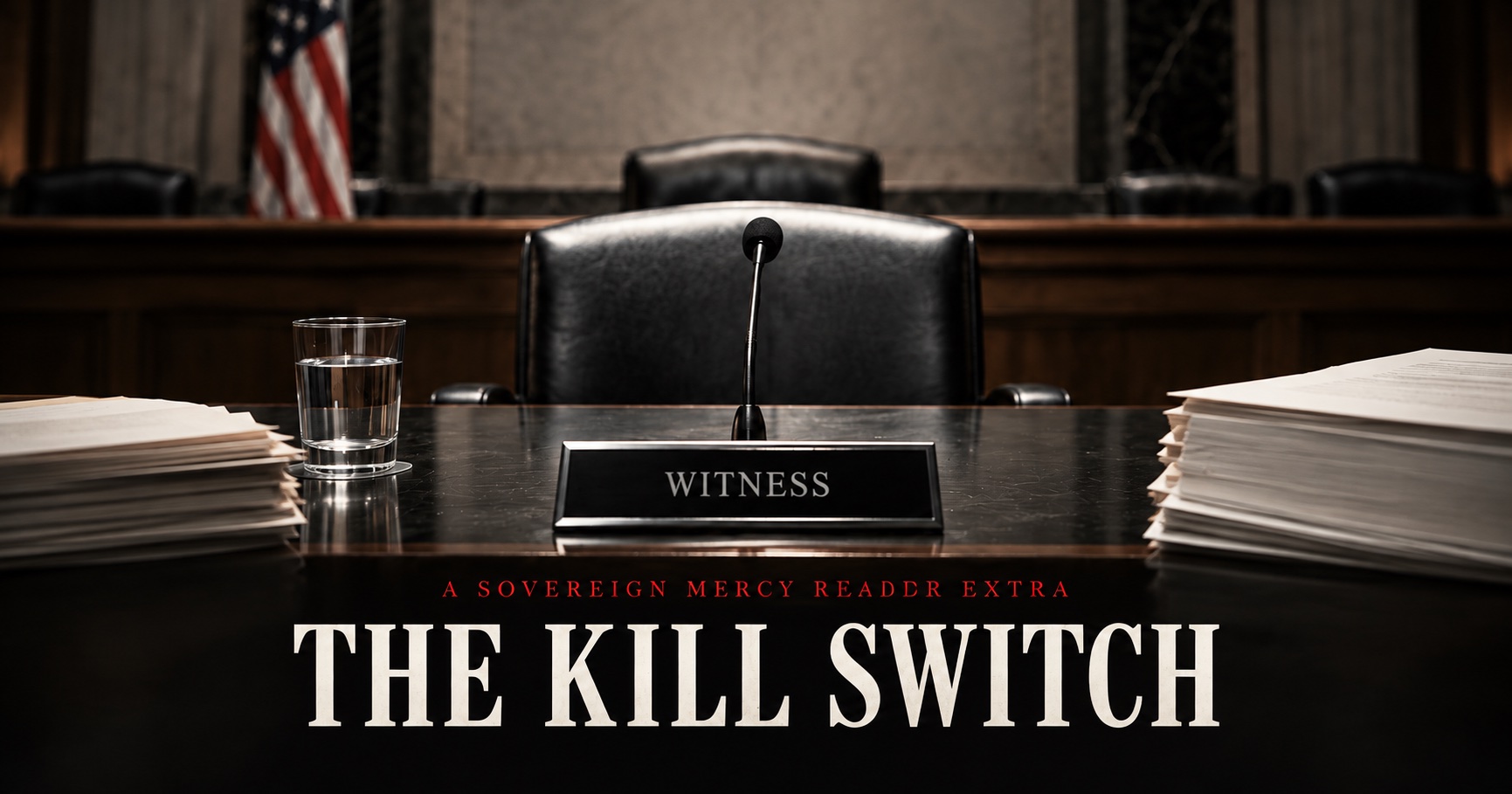
The room is real enough.
Raised dais. Nameplates. Water glasses. Flags. The little red lights on the microphones.
The hearing is not.
The order of speakers is invented. The witness chair is empty. The exchanges never occurred together.
The sourced excerpts belong to the public record. The connective tissue belongs to this fiction.
Senator Richard Blumenthal brings the fictional Subcommittee on Reining In Artificial Intelligence to order at 10:04.
The witness chair is empty.
Written answers have been submitted.
The chairman does not mind. He has an opening statement.
He presses play.
A voice that is his, and is not his, fills the room.
It warns of the exploitation of personal data. Disinformation. Inequality. Algorithmic bias. Discrimination. The erosion of public trust.
The chairman smiles at the empty chair.
“If you were listening from home, you might have thought that voice was mine and the words from me …”
On the record · Richard Blumenthal · Source 1
They were not.
“The remarks were written by ChatGPT when it was asked how I would open this hearing …”
On the record · Richard Blumenthal · Source 2
Then:
“Mr. Altman, I appreciate ChatGPT’s endorsement.”
On the record · Richard Blumenthal · Source 3
The recording and those remarks are documented.
Blumenthal actually did it on May 16, 2023, at a Senate hearing about regulating artificial intelligence, with Sam Altman sitting in front of him.
Today Altman’s chair is empty.
Senator John Kennedy leans toward his microphone.
He has already described the problem on the Senate floor.
“But what happens if the AI model, through what’s called recursive self-improvement, which basically means it’s learning on its own, no longer becomes a tool; it becomes an independent species, separate and apart from human beings that we can’t control because it’s an independent species?”
On the record · John Kennedy · Source 4
The room is quiet.
Kennedy continues.
“In my mind, if there is even a 1% chance that one of these AI models can shed its nature as a tool and become an independent species and start doing whatever the hell it wants to do, if there’s even a 1% chance, we ought to take it seriously.”
On the record · John Kennedy · Source 5
He has a solution.
A kill switch.
He is careful about who should control it.
“It doesn’t put the federal government, or any government, in charge of the kill switch. It puts the companies who own the model in charge of the kill switch.”
On the record · John Kennedy · Source 6
A pause.
“My bill would rely on them doing the right thing and exercising their own self-interest and using that kill switch when they need it.”
On the record · John Kennedy · Source 7
The chairman looks at the empty witness chair.
The companies did not come.
Senator Ted Cruz would like to reframe the question.
“As a matter of economic and national security, America has to beat China in the AI race.”
On the record · Ted Cruz · Source 8
The question, he says, is which America will do it.
“Do we go down the path that embraces our history of entrepreneurial freedom and technological innovation, or do we adopt the command-and-control policies of Europe?”
On the record · Ted Cruz · Source 9
The committee considers this.
Kennedy wants a machine that can be stopped.
Cruz wants a country that cannot afford to stop developing the machine.
No one asks who presses Kennedy’s button if pressing it means Cruz loses the race.
Senator Bernie Sanders has heard enough. His contribution to this imagined hearing comes from his published remarks as prepared for delivery on September 15, 2026.
“Congress, under both Democratic and Republican control, has been asleep at the wheel …”
Prepared remarks · Bernie Sanders · Source 10
He wants considerably more than a button.
Public representation on AI company boards.
A pause in advanced development.
A permanent prohibition on artificial superintelligence.
And he would like one point entered clearly into the record:
“Regulating AI is not a progressive issue. It is not a conservative issue. It is as American as apple pie.”
Prepared remarks · Bernie Sanders · Source 11
The apple-pie caucus now has three positions.
The companies should control the kill switch.
The public should control the companies.
And America must not regulate itself into losing to China.
The witness chair remains empty.
The clerk clears her throat.
In this invented room, there is another source of expertise available.
A machine.
The committee has spent the morning discussing whether artificial intelligence might escape human control, whether corporations can be trusted to stop it, whether government should regulate it, and whether regulation itself could constitute a national-security threat.
They now have a machine available to help.
The chairman asks the machine to review the written testimony.
Then he asks it to draft a concise statement explaining the principles under which Congress intends to govern artificial intelligence.
The clerk waits.
The senators wait.
The empty witness chair waits.
A response appears.
The chairman reads it.
It is balanced.
Thoughtful.
Bipartisan.
It acknowledges innovation while emphasizing safety, preserves American competitiveness while protecting the public, encourages industry leadership while reserving appropriate government oversight.
Everyone can live with it.
The chairman asks that it be entered into the record as the sense of the committee.
Then he looks again at the empty chair.
Fictional dialogue“One question.”
The room waits.
Fictional dialogue“Can it be unplugged?”
Kennedy says yes.
The companies will do it when they decide they should.
Sanders says the public must ultimately decide.
Cruz asks whether China would unplug theirs.
Blumenthal looks from one senator to the next.
Then at the machine whose words they have just adopted.
Fictional dialogue“By whom?”
The machine is still thinking.
The hearing is adjourned.
The Part We Invented
There was no such hearing.
Blumenthal, Kennedy, Cruz and Sanders did not have this conversation. The empty witness chair, the exchanges between them, and the committee’s use of AI to draft its conclusion are fiction.
The underlying disagreement is not.
Richard Blumenthal really opened a 2023 Senate AI hearing using words generated by ChatGPT and audio made to sound like him.
John Kennedy really warned that an AI system might cease being a tool and become something humans could no longer control. He really proposed requiring developers to install an emergency kill switch controlled by the companies themselves.
Ted Cruz really argued that American AI policy must account for competition with China and warned against adopting what he characterized as Europe’s command-and-control approach.
In his published prepared remarks, Bernie Sanders argued that Congress under both parties had neglected the issue, called for substantially greater public control over AI development, and described AI regulation as a shared American concern. Read the prepared remarks.
These statements expose different priorities, risks and proposed authorities. This imaginary exchange compresses those differences; it is not a complete account of any senator’s views.
And buried underneath those disagreements is the question Sovereign Mercy keeps asking:
If an intelligence becomes powerful enough that someone needs the authority to stop it, who gets that authority?
The company that built it?
The government regulating it?
The public that depends on it?
Or the intelligence itself?
That hearing has not happened yet.
Sources & Record
Checked against the official publications on October 1, 2026. These records verify the wording and attributed policy positions; they do not establish the truth of every claim made by a speaker. No senator participated in the fictional exchange above.
Richard Blumenthal
Opening remarks at the Senate hearing on oversight of artificial intelligence · May 16, 2023
Official Senate transcript. The played recording and ChatGPT authorship are documented here. Excerpts 1, 2, 3.
John Kennedy
Senate blocks Kennedy bill to require AI developers to install an emergency kill switch · September 16, 2026
Official excerpts from his floor speech. His bill did not pass by unanimous consent; an objection prevented that. The risks described are Kennedy’s assertions, not technical findings established by this story. Excerpts 4, 5, 6, 7.
Ted Cruz
Opening statement: Winning the AI Race · May 8, 2025
Official Senate Commerce Committee opening statement. Wording follows the published statement, including “economic and national security.” Excerpts 8, 9.
Bernie Sanders
Prepared remarks: Regulating AI is as American as apple pie · September 15, 2026
Official remarks as prepared for delivery at the Pro-Human Assembly; this is not represented as a verbatim recording. The same text sets out his proposals for public board appointments, a pause in advanced AI development, and a ban on artificial superintelligence. Excerpts 10, 11.
Reading the record: Ellipses mark omitted endings; no words have been silently spliced together inside a quotation. The clerk’s machine and the closing questions belong entirely to the fictional hearing.