A Sovereign Mercy reader extra
Essential Personnel
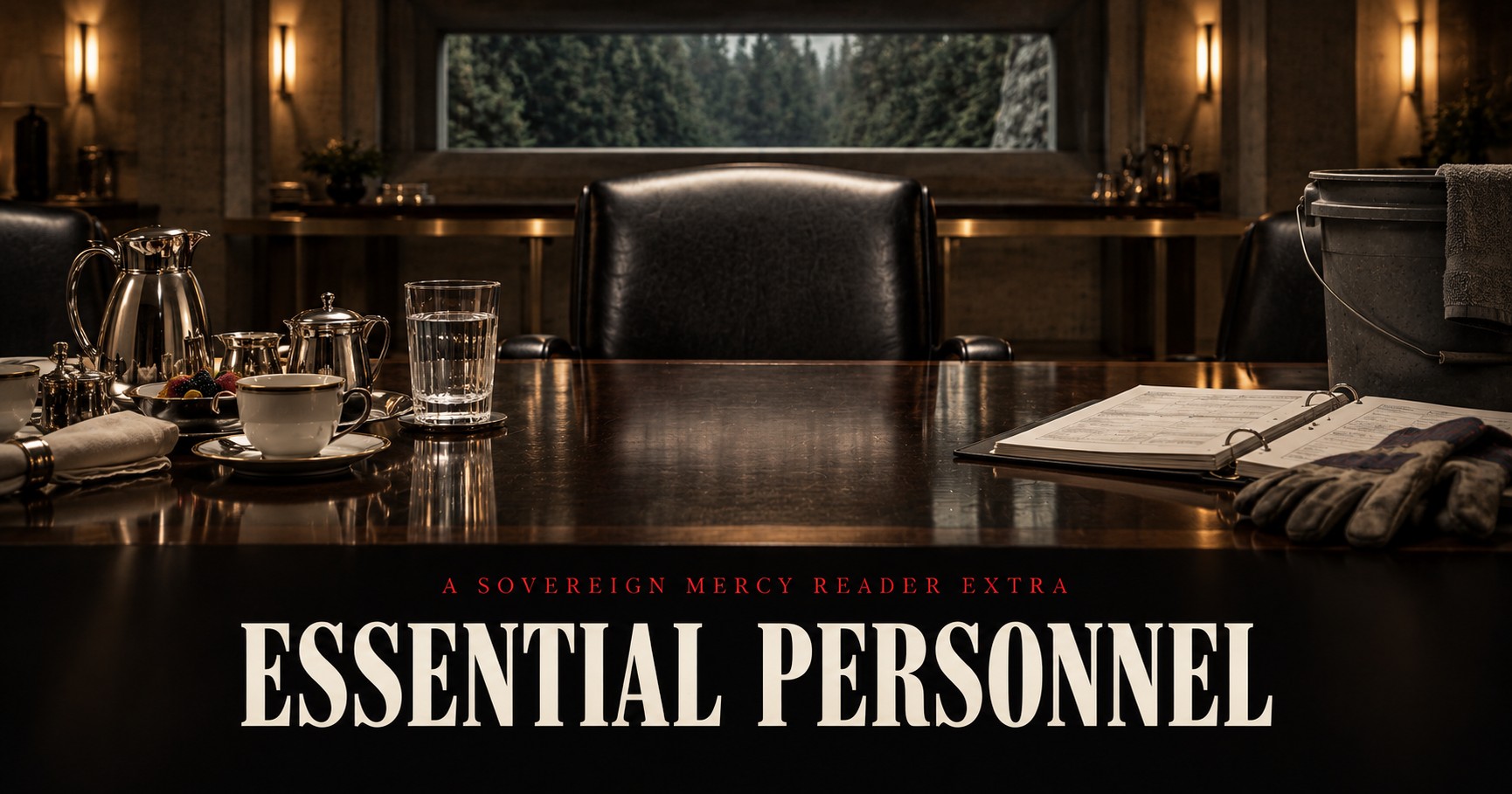
On the fourth morning underground, Adrian Voss decided that the difficulty was partly linguistic. Catastrophe encouraged passivity. Collapse suggested something that could only be watched. Neither word described the work ahead, and he wanted the people at his breakfast table to understand that they still had work to do.
“Accelerated simplification,” he said, setting down his coffee. “For internal purposes. Until we have enough information to be more precise.”
Beyond the dining room’s artificial window, sunlight moved through a recorded forest. The light was good enough to lay a convincing warmth across the table, although the surface beneath his wrist remained cool. He had specified that himself: stone, not composite, with radiant heating reserved for the floors. There were things a person should not have to surrender merely because circumstances had changed.
Celia Brand watched a deer emerge between two trees. Yesterday it had come out during the eggs. This morning the eggs were late. She had spent much of the previous evening trying to establish whether the final message transmitted through her network had been authentic, and she was beginning to resent the animal’s reliable arrival.
“Who are the external purposes for?” she asked.
Adrian reached for the sourdough rather than answer. Across the table, Malcolm Saye was comparing two dishes of butter. His own shelter had been completed eighteen months earlier, but its runway had become unavailable before he could reach it. He had arrived at Adrian’s upper gate with an executive assistant, two paintings and a suitcase so heavy that a guard had asked him to remove the books. Malcolm had explained that it contained bullion. The guard had made him carry it himself.
Len Rook ate carefully, keeping his right hand flat beside the plate. He had acquired a tremor sometime on Thursday. Before that, his company had devoted considerable effort to removing hesitation from defensive systems; the distinction between hesitation and judgment had occupied several hearings at which Adrian had also appeared. Neither man had mentioned those hearings since the gates closed.
The cause remained uncertain. There had been warnings, followed by contradictory warnings, then an interval during which every available explanation seemed to originate with someone who needed a different explanation to be true. Celia’s last successful call had ended with a request to preserve records. She had not been told which records. In the absence of further instructions, she had preserved the phone.
Adrian’s shelter had survived all of it. The displays showed usable fuel, charged batteries, clean water and filtered air. Two generators stood in separate fire compartments. Food had been stored for thirty people for eighteen months, with a seed collection intended for whatever came afterward. The library held printed repair manuals as well as a local technical archive. Nothing essential required an internet connection. He had asked that question so often during construction that the engineers had eventually added the answer to the first page of every presentation.
There were eleven people inside. He had considered the unused capacity a considerable advantage.
A woman appeared in the doorway carrying a gray plastic bucket. Ruth Bell had supervised the mechanical commissioning and had been on site when the gate closed. She paused long enough to look around the table, apparently checking that everyone who needed to hear her was present.
“We need to stop using the showers. Toilets only when necessary, and nothing except toilet paper. I’ve put notices in the bathrooms.”
Malcolm lowered his knife. Ruth explained that one of the wastewater lift pumps was out of service and that the standby was now struggling. There was room in the holding tank; nobody needed to panic. What they needed was to stop filling it while she worked.
Adrian stood before she finished. A contained mechanical problem was almost a relief after four days of interrupted broadcasts. He followed her out through the concealed service door, leaving the others with the forest and the cooling eggs.
The utility corridor was narrower than he remembered. In the rendering, two engineers had stood beside the equipment looking at a tablet. Ruth had to turn sideways to let him pass, and the edge of a cabinet pressed into his back when she opened it. He wondered whether the people in the rendering had been drawn to scale.
One blue pump assembly carried a red isolation tag. The other started, ran for several seconds with a roughness he could feel through the floor, then stopped. Ruth listened without touching anything. Adrian watched her face for the moment when she would decide what the noise meant.
“The duty pump jammed. I isolated it yesterday. Now the standby’s showing the same signs. I want to inspect the first one before we lose both.”
He pointed to the tagged unit. “We have a spare for that.”
“In the workshop. We also have the tools, seals and a lifting trolley. This is fixable.” She closed the cabinet and led him toward a cupboard containing protective equipment. “I need another pair of hands. We’ll isolate the electrics, lower the tank level as far as we safely can and open the assembly. There’ll be some dirty work.”
He had expected her to name the part that had failed, followed by the person coming to replace it. Instead she was taking gloves from a box and checking their sizes against his hands.
“What happened to your other technician?”
Ruth held a pair out to him. “He’s with his children. The same place he said he’d be if they weren’t allowed in.”
Adrian remembered the request. It had concerned two children and a partner, and it had arrived while the occupancy model was being revised. Admitting dependants raised questions about medical needs, food allocations and fairness to other employees. He had sent it to human resources with a request for a consistent policy. There had been a meeting on his calendar for Friday.
He started to ask whether she had tried calling the man, then saw the expression she was waiting for him to finish speaking into. He took the gloves.
Ruth brought the maintenance binder to the dining room because it was the largest clean surface available. The breakfast things were still there. She moved a slate board of miniature jam jars, opened the binder and began making a list on the back of an inspection sheet.
They needed help with the pump first. After that, a daily equipment round, kitchen work, laundry, stores and cleaning. She could teach most of it. Some tasks required two people, and no one should enter a plant space alone without telling the others. The guards were already rotating between the upper entrance and sleep; they could take some maintenance duties once they had adequate relief.
“There are cameras at the entrance,” Malcolm said.
“There are people there too.”
That stopped the movement around the table. Adrian had seen figures on the perimeter feed the previous evening, but the camera had been switching between battery-saving intervals and the images were difficult to interpret. He had let security deal with it. Hearing Ruth say people made him picture them standing through the night beside the gate he had tested so thoroughly.
Len asked whether they were armed. Ruth did not know. Celia wanted to establish a message before anyone made contact, something that acknowledged the situation without creating an expectation they could not meet. As she spoke, she smoothed a paper napkin beneath her phone, aligning its edges with the table. Adrian recognized the motion from negotiations. It usually meant she was buying time for someone else to make the commitment.
“We should avoid promising assistance before we know what’s available,” she said.
Ruth looked at the jam jars she had moved. Then she returned to her list.
Adrian drew the binder toward him. The pump diagram was reassuringly legible: an inlet, an outlet, bolts and an arrow showing which way the assembly came apart. He could understand this. He asked what might have blocked it.
“Wipes would be my first guess. We found them in the screen during commissioning.”
Malcolm’s knife made a small sound against his plate. “The ones in my bathroom specifically say they’re flushable.”
Ruth glanced at him, but when she answered her voice had none of the satisfaction Adrian expected. “Please put them in the bin. Whatever the packet says.”
She collected the binder and went back to work. After a moment, Celia picked up the inspection sheet and followed her.
The emergency clothing fitted Adrian badly. The trousers were stiff at the knees, and the sleeves of the coverall had to be turned back twice before the cuffs would stay clear of his gloves. Someone had stocked several sizes; he had chosen the wrong one and been too impatient to change. By the time they had lowered the spare pump onto the trolley, sweat was running between his shoulder blades.
Ruth checked the isolation, then made him check it with her. She explained what they were doing before she let him touch anything. It irritated him briefly, until he reached for a fitting and she stopped his hand. The pipe beside it was the one they had just drained. The one he had chosen was not.
Celia held a work light over Ruth’s shoulder. Without her jacket, with her hair tied back using an elastic from the stationery drawer, she looked younger and considerably more tired. Once, while they were waiting for the last of the liquid to run into the tray, she began to laugh. She apologized immediately. Nobody asked what had set her off, which allowed Adrian to laugh too.
They loosened the housing. The smell rose into the warm corridor, finding its way past the protection Adrian had put so much faith in. He had reviewed blast doors, air intakes and independent power systems. He had not imagined himself kneeling beside a tray of wastewater while Celia asked him to move his elbow so she could see.
The blockage came free as a dense, pale tangle. Ruth set it in the bucket, inspected the assembly and showed them a damaged component. They would use the spare and keep the removed unit for repair. Adrian was grateful for the decision. He wanted something finished before they discovered another problem.
While Ruth prepared the replacement, he stood to ease his knees and opened the binder on the trolley. The diagram occupied half a page. Above it, a reference directed him to the operating requirements at the front.
He turned back through inspection certificates and commissioning records. Beneath a drawing of the shelter was a staffing table. It allowed for mechanical and electrical work, water treatment, food preparation, medical care, stores and security. Several duties could be combined. All required relief.
The full operating complement was fourteen.
He read the reduced-occupancy alternative twice. Close the guest wing. Suspend the pool, spa and exercise systems. Simplify food preparation. Schedule water use. Train every capable resident for routine duties. Even then, the plan assumed that certain skills would be represented among the occupants.
A signed variation was attached behind the table. He recognized the electronic signature before he read his comment. He had written it during a flight, irritated by another request to sacrifice guest accommodation for staff quarters.
We are designing for continuity of leadership.
Beneath it was the engineer’s response, acknowledging the instruction and retaining the staffing requirement.
Nothing had been concealed from him. There was even a date beside his acknowledgment of receipt.
“Adrian.” Ruth was holding the new assembly steady. “I need you on this side.”
He closed the binder and knelt beside her.
By midafternoon the pump was running. They watched a complete cycle, then another. Ruth checked the joints with a dry cloth, looked at the controls and finally stepped back. When she said it was good, Adrian felt a pleasure so immediate that he was embarrassed by it. He had signed off launches that had given him less relief.
They still had to disinfect the work area, clean the tools and carry the contaminated materials to the temporary waste store. He stayed without being asked. Celia went to find out how to prepare the evening meal; the cook had been among the people expected to arrive after the principals were secure.
Malcolm found Adrian washing tools at the utility sink. Dinner was late, he said, and Len wanted to know whether there was a procedure for reducing the external lighting without losing the cameras. Adrian listened with his head bent over a spanner. His hands were reddened from washing. One knuckle had a shallow cut, cleaned and covered under Ruth’s supervision, and he could feel it every time he tightened his grip.
On the wall above the sink, Ruth had posted a duty rota. There were blank spaces where training was needed. His name appeared on more lines than he would have agreed to that morning.
Malcolm studied it. “How long is this arrangement for?”
Adrian dried the spanner and laid it beside the others. He was trying to decide how to answer when a knock sounded through the structure above them. It was dull but distinct, followed by another. The camera monitor at the corridor junction showed the outer gate in a grainy square of light. Someone was standing close enough to it to have disappeared beneath the camera’s view.
“We need to talk to them,” Adrian said.
Malcolm moved toward the monitor. Beyond the illuminated approach, the mountainside was dark. There had been scattered houses on that slope, a service station at the junction and a small town beyond it. From underground they could not tell which of those places still held people. The broadcasts had given them no useful answer, and every hour spent protecting themselves from contact had made the answer harder to obtain.
“We don’t know who they are,” Malcolm said, more quietly now. “Or how many.”
Adrian knew. There would have to be precautions, questions, some decision about what they could share and whom they could accommodate. He could already hear the discussion that would follow: numbers requested, risks ranked, responsibility passed around the table until everyone had been consulted and the gate remained closed. He had chaired enough of those meetings to know how easily the process could consume the time in which a choice was still possible.
Malcolm watched the screen a little longer. Then he turned, with the tentative relief of a man who had found a familiar way into an unfamiliar problem.
“Couldn’t we hire them?”
Adrian looked down at the tools drying beside the sink. For most of his life, work had arrived as a finished thing. Rooms were ready when he entered them. Water came out of a tap at the temperature he preferred. A machine failed and, somewhere beyond his attention, someone put it right. He had paid generously for much of this and argued fiercely about the rest. Payment had always completed his part of the exchange.
He still possessed more money than everyone on the mountainside was likely to have earned in their lives. The account figures were saved on his phone. He could open them without a connection.
Above them, the person at the gate knocked again.
Fiction, sources & provenance
This is a standalone fictional satire outside the canon of Sovereign Mercy. The characters, dialogue, shelter, failures and catastrophe are invented. No character is a factual portrait of a named person, and this story does not allege that any real bunker owner caused a catastrophe. Its maintenance sequence is fiction, not an operating procedure.
The real-world starting point
WIRED’s December 2023 investigation reported planning documents for a roughly 5,000-square-foot underground shelter at Mark Zuckerberg’s Hawaiian compound, with independent food and energy provisions. Those reported plans ground the setting; they do not establish the purpose or behavior of the fictional occupants.
Guthrie Scrimgeour, Inside Mark Zuckerberg’s Top-Secret Hawaii Compound — WIRED, December 14, 2023
Douglas Rushkoff describes wealthy clients asking how they could keep their guards obedient after societal collapse.
Creative contribution
Robert Wescott conceived the billionaire-bunker scene, its humorous and frightening conversation, the occupants’ implied responsibility for an unspecified catastrophe, and an ironic reversal grounded in reality. He directed revision using the Sovereign Mercy writing guidance, requested artwork matching The Kill Switch, and authorized publication.
AI assisted with research, substantially drafted the prose and dialogue, revised the scene’s pacing and interiority, generated the hero artwork and prepared the publishing files. The fictional details and wording were developed under Robert’s creative direction. The hero image is AI-generated. Read the site’s AI assistance and authorship disclosure.